Wednesday, September 10, 2008

Guest Article - Medium Format Color IR Film

Hello loyal IR Buzz Readers. I am placing this on the Buzz in the Guest Articles area, as I consider it more a technical posting than anything else. But actually it is more a story of an adventure in IR and Film Photography that began when I received the following introductory email from a fellow IR photographer in Germany.

Hi Jerry,

Thanks for working to keep IR photography alive!

I have been interested in IR photography for years, shooting both B&W and Color. Many people were upset and discouraged when Kodak discontinued EIR color infrared for 35mm including myself.

Then I saw the old Kodak expired film selling for up to $50 on ebay even when it was 10 to 15 years expired. The IR effect must suffer greatly with those rolls, but it shows that there is a demand.

I called Kodak Technical advisor for EIR at length and many times. Kodak EIR was obviously cut due to low demand.

The only color infrared film now available anywhere in the world is the Kodak Aerochrome which comes in 9.5 inch bulk rolls and of up to 400 feet. They cost a few thousand each. I have no money, but decided to take a shot at cutting it down for 120 medium format. After much experimentation and painstaking research and testing, I now have a product. The rolls are cut, rolled and packaged in total darkness. It is a difficult task. I have sold a few hundred rolls online with very positive feedback. I myself am very very happy with the results.

The film is normally used at 15,000 feet altitude by agriculturists and scientists to determine crop failure, forest disease, map making, etc. However, digital is slowly phasing that out too and soon enough Kodak will discontinue this film as well.

The tech supervisor at Kodak assured me that it is an identical emulsion to EIR for 35mm. I tested and tested and rate my film faster, with an asa of 400, whereas EIR 35mm is rated at 200. Otherwise it yields the same results. The UV factor of the film is also interesting with measurable response at 400 nanometers. Intrigued, I put a Baader U2 filter (a standard pure-UV-pass filter) on the camera and ran some bracketed test exposures. The working ISO turned out to be in the 20-30 range, comparable to that of many b&w films, but very unusual for a color film. (by comparison, Fujichrome tungsten has a working ISO somewhere around 0.05 under similar conditions.) Moreover, the image showed evidence of color discrimination, which Fujichrome fails to do, producing only monochromes.

I am not am outstanding photographer, but the film is outstanding and the only of its kind in the world. If more people knew, then there would be more activity in IR fim photography. That is the real goal. I hope to see demand increase to the point that Kodak or other film producers do not completely phase this film out. The whole process of preparing 120 paper backed film rolls is so difficult and time-comsuming, that the idea of profit does not motivate me. I will not profit from it, indeed I have lost a lot of money. However, it is worthwhile, isn't it? I would like to present my story and my photos on your blog. Attached are a few example photos. Thanks for your time.

Regards,

Dean Bennici
Munich, Germany

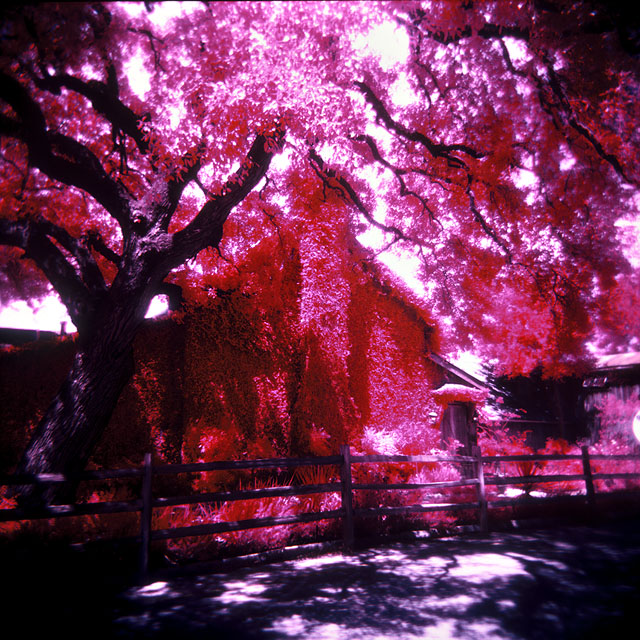
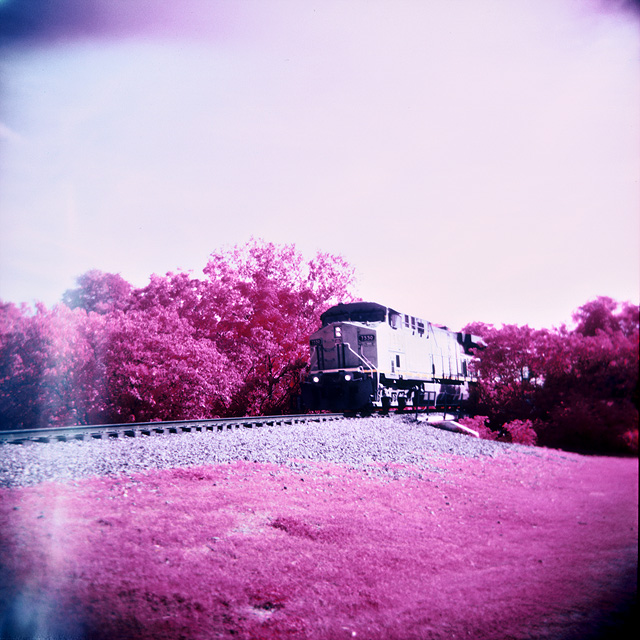
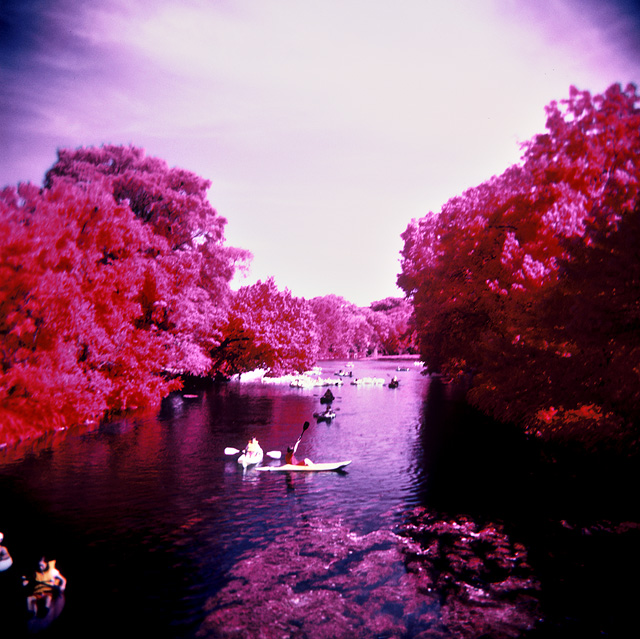
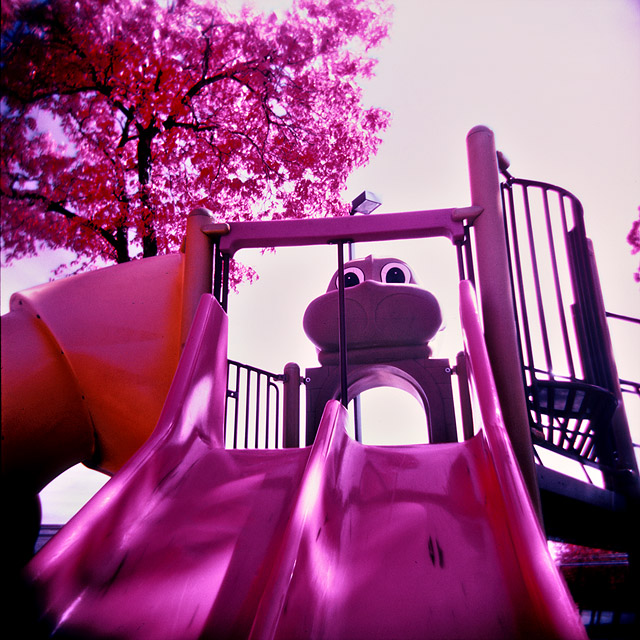
Dean attached the following example photos taken with the film that he describes and offers to IR Color Infrared Photographers, keeping the flame alive. I must say that I take exception with his humble assessment of his own photography skills. I think that these examples are exceptional, and I believe that you will agree.

If you are interested in purchasing some of this rare film, or checking out a few more photos:

Dean's Website

After a few more email exchanges, Dean composed and sent along additional information to flesh out details. There may be some details repeated from his original email, but I prefer to leave his writing intact to retain his original flow, so I suppose that this is where the Guest Article actually starts.

Hello, my name is Dean Bennici.

I am an American, born in Pasadena, California.

I have been living in Germany for the last 10 years. I have been thinking seriously about photography for about five of the those ten years. I started out shooting pop photos for songwriters here in Munich. That is what brought me initially to Color Infrared Film. I wanted something special for these special projects and I tested EIR 35mm with some success.

I became even more attracted to the curve of the film than I am to the color reversal aspects. So many users put the emphasis on the color reversal, but the characteristics of the curve is indeed noteworthy! My challenge has been to find the right IR style for me. There's no end to the experimenting and I am often surprised.

As I was experimenting, Kodak suddenly removed EIR from the market and in an instant, the only film was expensive second-hand, and offers of extremely outdated film. This event prompted me to start this project. I was aware that Kodak makes Aerochrome 1443, which is the only remaining CIR in the world. After numerous emails and conversations with Kodak experts and other individuals, I came to the obvious conclusion that 1443 is the last chance, especially in this age of digital. I loved and missed EIR and I imagined that many other users must feel the same. I decided to cut the 1443 down to 120 medium format rolls. Obviously, I was not the first to think of this, but the only other guy that I could find stopped cutting down a few years ago. I ran a few forum threads to see what the interest was and found adequate response to try the project.

I started from scratch, so the trial and error was expensive and exhausting. I also needed to learn a lot more about IR photography, if I was to test the stock accurately and I needed a foolproof system for construction, design and application, if I was going to offer it as a product to the public. The liability and responsibility is pretty high. The film is expensive and so is peoples time, energy and work, especially on a photo shoot.

For the design, I mimicked exactly a standard 120 paper backing and roll construction. I looked at 6 different paper backings and designed my cut around an average of all of them. Measurements are critical down to the millimeter. The actual paper that I use is recycled from used rolls.

Handling the bulk film material is a completely different matter. The rolls come delivered in dry ice on 400ft (241 m) spindles. This raw stock needs to stay in a deep freezer to ensure freshness. Cutting down poses many problems, the most difficult being that everything must be done in total darkness, with not even a safelight. I like to plan a large cutting session, because the film must thaw for several hours before any handling whatsoever. I don't want to thaw and refreeze over and over. The first cut phase is to chop them into lengths.These lengths are then split down into 120 film strips. I place them then back in the freezer until rolling time.

The paper backings are then prepared with the necessary binding tape and marked off for rolling. Again, rolling is done in complete darkness. The film strip must be aligned perfectly with the paper backing and spindle right down to the millimeter, or the rolling won't go smoothly. A rolling that is misaligned can cause scratching or wrinkling and won't roll straight, forcing one to abort the procedure. Futhermore, dust, humidity and fingerprints are a huge factor. Although gloves are used throughout most of the process, there are some instances when bare hands are necessary. A breakdown in the procedure in total darkness can be very costly, so patience and focus are important at all times.

After rolls are wound, they are bound with the fastening tape and placed in air tight, light resistant film containers and are ready for delivery. Each film container has a lead-based x-ray shield insert to help in preventing damage due to x-ray during transport. The insert also better secures the roll tight in the container. In any event, I have never had an x-ray incident in the past.

The most frequently asked questions are about filters and the ASA. Different filters produce different effects and it is somewhat a matter of taste here. I lean toward the light orange filter range and I have tried many makes and shades. Everyone is quite partial to the Tiffen #12 yellow, perhaps because they find it works better with landscapes. Landscapes do seem to be what most people shoot with CIR film. I take IR portraits and the yellow filters most of the time don't give me what I want. Some buyers of the film have used the B+W infrared 099 filter with excellent results. It pays to do some research before choosing a filter to suit your application with something as tricky as infrared light.

There seems to be some confusion about the relative ASA for the film, because Kodak states that it is the same emulsion as Kodak EIR 35mm. Kodak EIR 35mm has a relative ASA of 200, compared to this film which is faster, with an ASA of 400. Otherwise, they perform the same. The product is originally designed to be used at 15,000 feet above sea level. The ASA at 15,000 feet is 40. I have made many tests in order to determine the ASA at sea level. As with any infrared film, time of day, position, intensity and quality of light source, hemisphere in which the photo was taken, and many other factors all play a role in infrared exposure. The 400 rating was conducted using a light orange or yellow #12 filter. The feedback from buyers supports this rating as well, so anyone insisting that my film be rated at 200 will be disappointed. My tests were conducted on clear days in the sun at about 3:30 in the afternoon. Subsequent testing was done in the shade and with extreme backlight.

Beware that filters in different ranges may require a different ASA. This is true with all color infrared film. The difference between the 525LP and the U2 is an extreme example. For basic, sharp-cutoff yellow filters such as a 525 dichroic or a Wratten or Tiffen 12, 400 ASA in clear daylight is a good relative rating. However, it may be advisable to expose an extra stop or more in the shade or in dense fog. For UV light, the Kodak 1443 spec sheet sensitivity graphs for all emulsion layers shows measurable response at 400 nanometers. Test exposures with the Baader U2 (a standard pure-UV-pass filter) yielded a working ISO in about the 20-30 range, compared to Fujichrome tungsten which has a working ISO somewhere around 0.05 under similar conditions. This makes it perhaps the fastest ultraviolet film on the market! Moreover, the test images showed evidence of color discrimination, which Fujichrome fails to do, producing only monochromes. The middle emulsion layer is much less sensitive to UV than the outer two , so you can get some really big magenta casts.

The discussion of filters can go on as long as the subject itself. One may experiment and do research as to all filter effects. The possibilities are limitless. For example, persons lips may appear orange when using an orange filter. There are a variety of tricks such as using light green lipstick to balance the lip color so it appears normal. Holga users also are attracted to the film. The combination of color IR and a Holga camera could offer some positive, interesting results.

Other questions often asked are which precessing to use and whether or not one needs to adjust the IR focus as with black and white infrared film. This film is designed for normal E6 or AR-5 processing. A negative can also be produced by cross-processing in C-41. The focus does not need to be IR adjusted. The sharpness of the CIR is dictated by the sharpness of the blue component. This is produces by the light green. Therefore, one only needs to focus visually.

The medium of CIR photogrpahy is not new, but in fact one near extinction. Therefore, all of the answers regarding color infrared photography are well documented and anyone wanting to use the film is encouraged to do some research and find what's best for their particular application. Using Infrared film effectively requires a basic understanding of infrared light, infrared film handling and exposure, filters and processing, all of which can greatly affect the outcome of your photos.

Dean offers these closing notes and thoughts about the future of IR Color Film.

The future of color infrared film looks grim. The film is still on the market in bulk form only to supply a handful of scientists, topographers and agriculturalists who still use it for studying crop decay, erosion and forest disease. They will undoubtedly soon enough replace their costly aerial analog cameras with the more practical digital version. At that moment, color infrared film will be extinct. Kodak debates regularly the decision to remove it from the market due to low demand. The same fate that EIR suffered in recent times.

Finally, since Kodak has discontinued the EIR 35mm, there has been and will be no replacement for that product. I have made an attempt at bringing this film to market based on that event. I have met great adversity. Legal issues, high costs, and technical problems have all contributed to my difficulties. Many people are skeptical and many more have complained about the cost of the film. I can only say that my profits are low. Between the material costs, paypal and ebay fees, tax, overhead, time, postal liability, etc., one can only say that I am doing this out of a passion for this film and for the waning art of analog photography. Here is a very rare and very real opportunity to enjoy this amazing, beautiful film stock.

Dean Bennici

The Adventure and Story Begins: OK, so with this VERY interesting information in hand, I asked Dean if I could obtain a roll of his film to run a relaxed "test" in order to add my personal experience to complete this article. I wanted to shoot a roll the way most IR Photographers would shoot, not turning it into a super technical evaluation. Go out in the field and find and photograph interesting scenes, and have fun doing it!

The roll arrived from Germany in excellent shape, well packed, and much quicker than I ever imagined something could show up from half way around the world. Well done, so far. Inside the bubble pack envelope, the film was protected by a 120 plastic film can. On the can was a very good identity label with cautions to load in a low light situation. Also on the label is processing instructions (E-6), and an expiration date. The Processing reminder is very helpful when you get to your film lab. There is no question or mix-up as to the required developing processing instructions, unless of course you want something custom done, which then is between you and your lab.

Also inside the envelope I found an invoice telling me exactly what to expect to see on my PayPal account. No mystery here... There's always an invoice..... such is life. Anyway along with the invoice Dean included a very easy to understand printed sheet with facts about shooting the film, suggested ISO setting, and reminders about using on-lense filters. All-in-all things seemed very simple, and I can assure you that's the way it turned out in my experience.

So, film in hand, I loaded it into my Holga, just being normally careful to choose a somewhat low light situation. I usually do this when I load regular B&W film anyway, so no really extra precautions were taken.

This film is just too special to go out and waste it on "just any" scenes, so I put the camera back and waited for an opportunity that I thought worthy of the film. I didn't have long to wait. Sheryl told me that she heard good things about the shopping at a couple of outlet malls in a town a few hours away. She wanted to take a shopping week-end! Problem is she doesn't like to take me shopping. I'm the "go in, get it, pay, and leave" type. She's not. What to do? Wait a minute.... that town is where Jules Alexander lives. If you don't know Jules, he's the owner and operator of simply the VERY BEST IR Forum out there The Worldwide Infrared Photography Community 2.0

BINGO! A few emails to Jules, and we are set. Jules and I had never met face-to-face, although from his work with his Forum and mine on this Blog, we felt that we already knew each other. When I told Jules we would be "testing" this IR Color Film, he was as excited as I.

The week-end finally came around and we made our short travel. Jules greeted us upon our arrival, and he and his family were just the most gracious and helpful people you could ever meet. Saturday came around and Sheryl went off armed with the credit card. Jules showed me around his town from the IR Photographer's perspective. He provided a Yellow and an Orange filter that happened to fit my 58mm adapter ring that I had on the Holga "Optical Lens". We decided for the 'test" that we would each shoot 6 of the 12 120 frames, to see what we would get. It was really hard to restrain and "save" the next frame for the next great IR scene that Jules knew about. We chose to use the yellow filter, and true to the decision to "go out and shoot" we used that Yellow filter for all 12 frames. Later realizing that we should have given the orange filter a try on at least a few of the frames, but we enjoyed our experience and that was the most important thing.

On Monday, I located a local Photo Lab and dropped off the film in the can. I made sure that they knew that the film was IR and not to load it into their automated machines, but to develop it by hand. Why should you be so particular? Well most of the newest automated film processing machines use an internal IR LED to locate and count frames as it is developing the film. This can fog your film. The person at the Lab knew why I made this request, and that set me at ease in leaving the film with them.

I develop my own B&W film here at home, and I have an Epson 4490 flat bed scanner to scan the negatives. I can then post process the image files and print them if I desire a paper copy. Having this capability, I asked only for development of the negatives, and I had them professionally scan the frames to TIF files delivered on a DVD disk. I did not need printed copies, so I saved the cost of prints. Total for processing came to just over $10 US. Not bad!

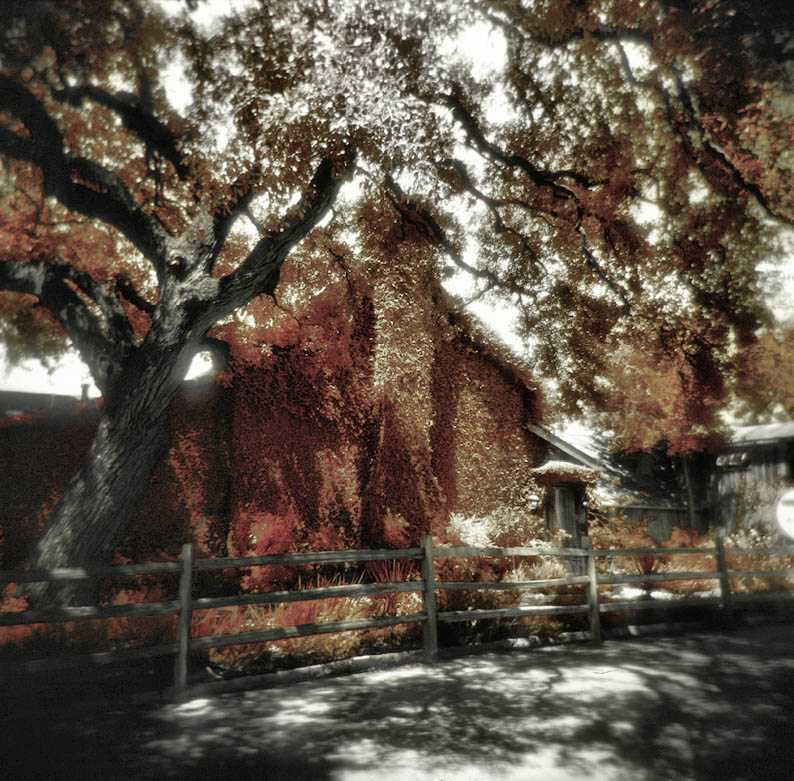
The results are like nothing I have made in my photo career. The most obvious IR result with this film is that foliage comes out red instead of the mono whites in traditional IR Photography. Many other subtle colors pop out. I suppose that the best thing to do is just post our pictures so that you can see what you may expect when you give this a try.

The following Images are made by Jules Alexander, and are used with his permission.


This is the same image, Jules has applied some expert Post Processing to get this:
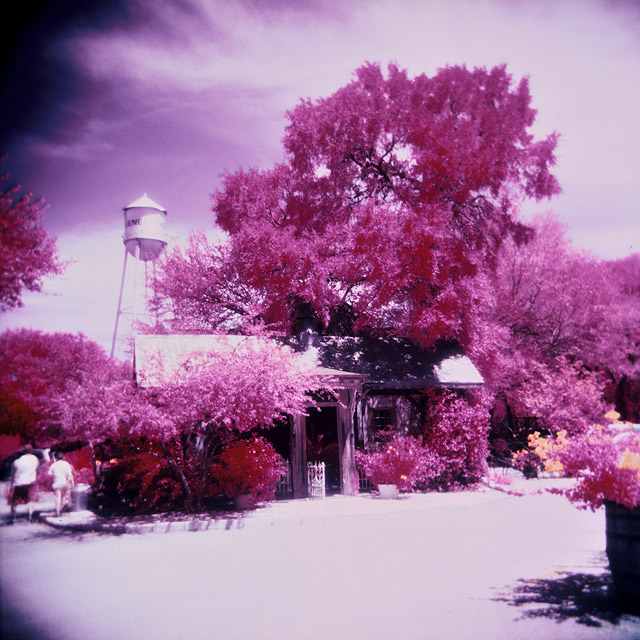
The following images were taken by me:
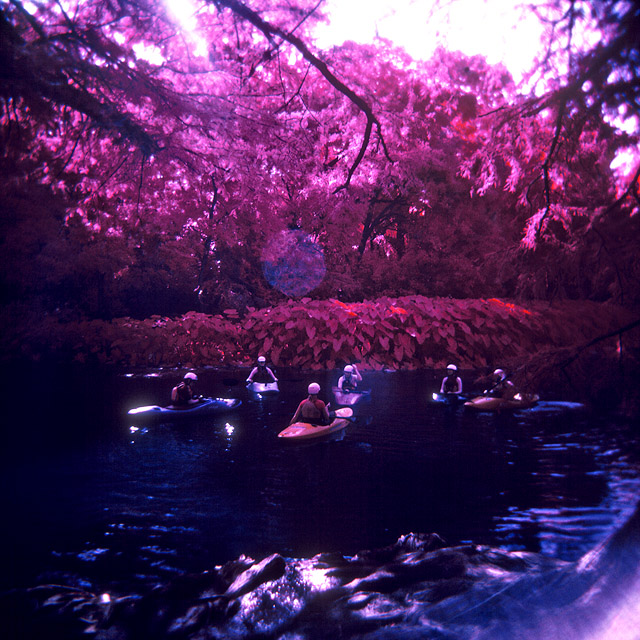
My final judgement is that I am really impressed by the results you can achieve with this film, despite it's high cost. If you want to give it a try, here's Dean's contact site.

Dean's Website

Copyright Statement: All images and materials displayed and showcased here, are copyrighted and are the exclusive property of the artist. Images and material may not be reproduced or used in any way without the written consent of the artist.

-=- Jerry -=-

4 comments:

Jack Cabbage said...

Definitely a unique look. Looking forward to seeing more.

Jonathan said...

A very interesting post!

I have recently ordered some rolls of the film from Dean. I am thinking about having the film cross-processed in C-41. Have you tried this yet? If so, I would be very interested to see your results!

Cheers!

Jonathan

Blog - http://minamitne.wordpress.com

Flickr -
http://www.flickr.com/photos/minamitane

Infrared Photography Buzz said...

Thanks Jonathan,

No, This is the only roll so far, but I have 2 more rolls to shoot. Why don't you email Dean and see if he has Xprocessed any yet.

-=- Jerry -=-

Anonymous said...

hi guys,
yes,have cross-processed, but i really do prefer E6. X-ing tends to produce a larger color casr in my experience. cheers and kepp on click'n

dean